What does quality really mean in the lives of people with intellectual and developmental disabilities? It means more than effective services or well-run programs. It means having choices, building meaningful relationships, participating in community life, and shaping one’s own future.
Since 1991, the Reimagining Quality Conference, originally called Reinventing Quality, has brought together people with disabilities, direct support professionals, families, service providers, researchers, and policymakers to improve people's lives. By connecting research, policy, practice, and lived experience, the conference turns ideas into action to strengthen person-centered supports, expand community inclusion, and help people live the lives they want.
This year’s conference, held in Baltimore, explored both the challenges facing disability services and the possibilities for change. Opening speaker Kate McEvoy , the executive director of the National Association of Medicaid Directors , emphasized the stakes of current policy debates for people and families served by Medicaid and the Children's Health Insurance Program (CHIP). “These are intense times,” McEvoy told the audience. “We are seeing changes in funding and benefits coverage, and it’s important for Congress and all of us to support a stable structure and continued funding for Medicaid.” Her remarks underscored how policies, funding, and workforce capacity affect the ability of people with disabilities to live in their communities and make their own choices.
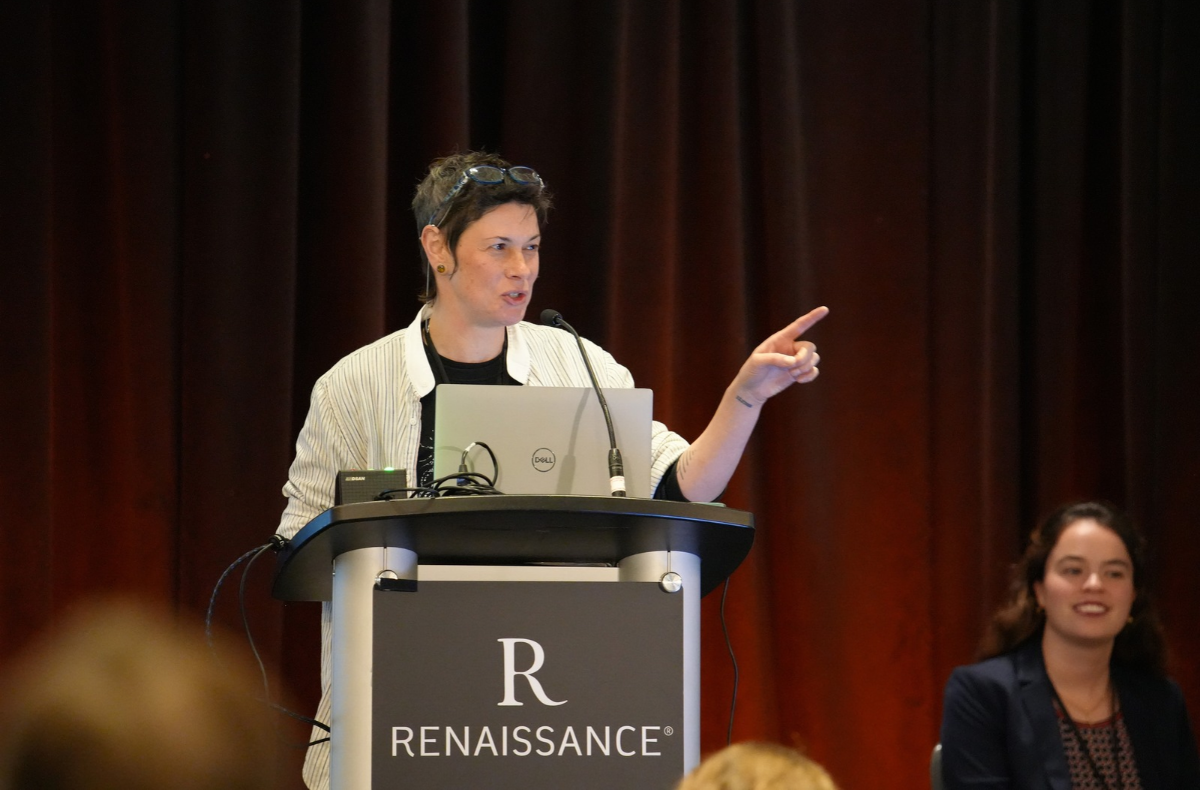
The conference was organized into 10 strands, or topics of interest, for those involved in the disability field, including sustaining and strengthening the direct support workforce, person-centered supports and self-determination, and the power of storytelling. In “From Research to Action: Clear Communication for Inclusion and Impact,” ICI’s Jerry Smith was joined by Rebecca Monteleone from the University of Toledo. Smith highlighted what he called “the missing middle in communications” and stressed the importance of clear, plain language when communicating about research results. “Funders of research do want to know the outcomes, and we have to present it in a way that is understandable and shows why this research is important,” Smith said.
Monteleone, who leads storytelling workshops for people with IDD, emphasized that communication is also about who gets to shape the narrative. “When someone else controls the story, people with IDD often are presented as victims or objects of pity and inspiration. People with IDD should be encouraged to share their own stories because it matters whose voice we’re listening to.” Other strand presentations reinforced this theme: advocates Harri Kannan and BJ Stasio offered guidance on telling one’s own story, while ICI’s Greta Cunningham explored narrative as a tool for change. Together, the presentations highlighted a central conference theme: improving quality means making knowledge accessible and ensuring people with disabilities help define problems, shape solutions, and tell their own stories.
ICI staff also shared research and practical strategies for addressing the direct support workforce crisis. Julie Kramme and Sandy Pettingell presented approaches to stabilizing the workforce, with Kris Foss joining them to examine effective strategies in greater depth. Julie Bershadsky explored how statewide policies relate to workforce outcomes, underscoring the role of policy in shaping the conditions needed to recruit and retain direct support professionals.
The importance of access and communication also emerged in the plenary session “Promoting Access with Assistive Technology and Knowledge Translation.” Educator and disability rights advocate Jordyn Zimmerman described not gaining access to an augmentative and alternative communication device until she was 18, despite being diagnosed as autistic at a young age. Zimmerman uses a speech-generating device on an iPad and told the audience that “Communication is the access point for daily life,” and added, “A lack of speech does not mean a lack of language.”
The closing plenary, “Where Do We Go from Here?,” brought together Joe Macbeth of the National Alliance for Direct Support Professionals (NADSP), Barbara Merrill of the American Network of Community Options and Resources (ANCOR), and self-advocate Nicole LeBlanc. Moderated by NADSP’s John Raffaele , the discussion highlighted the need to recognize and adequately compensate DSPs, protect community living opportunities, and recognize disability as an issue that concerns everyone. “Anyone can join the disability community at any time,” LeBlanc reminded the audience. “That means everyone should be concerned with how all people are being treated.”
As the conference closed, Raffaele invoked John Lennon's song Imagine, encouraging participants to carry its vision of a more inclusive world beyond the gathering. More than three decades after its founding, Reimagining Quality continues to challenge the disability field to look beyond established systems and practices. Its purpose is to turn shared knowledge into meaningful change, and to measure progress not simply by the services delivered, but by whether people with disabilities have greater choice, stronger relationships, fuller participation, and a genuine sense of belonging in their communities.
View Original Article