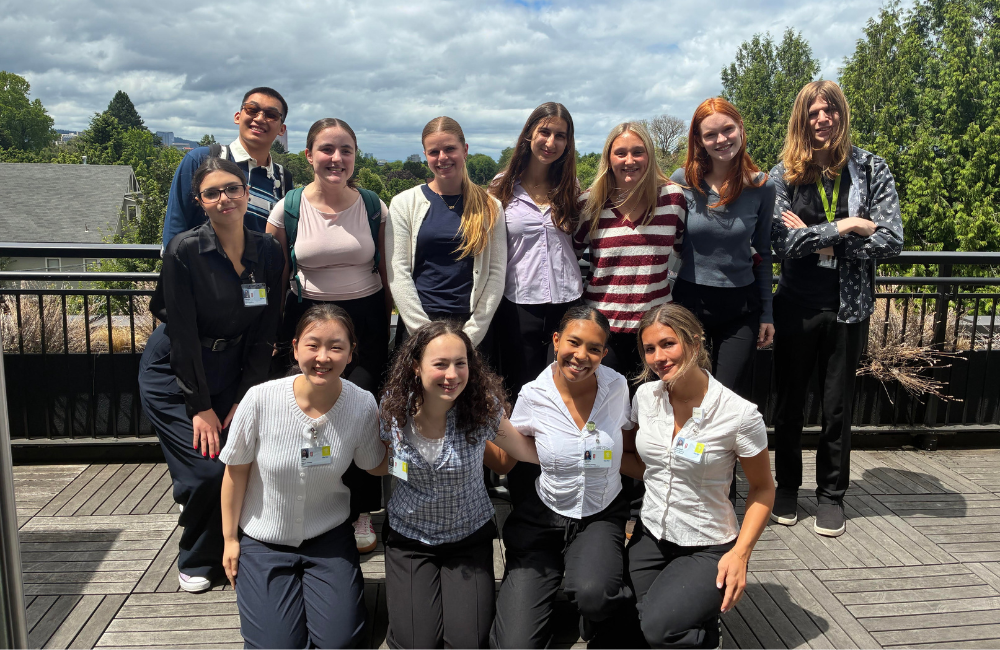
The UCEDD Summer Internship Program at OHSU’s Institute on Development and Disability provides opportunities for Oregon high school or early college students to gain experience in the disability field, develop transferable skills, and learn about various career paths in health care. The long-running program had 12 interns this year. One intern reflects on their experience:
My name is Jona Yoo, and I am an undergraduate pre-medical student studying molecular, cellular, and developmental biology. This summer, I had the privilege of interning at Oregon Health & Science University (OHSU) for eight weeks through the University Center for Excellence in Developmental Disabilities (UCEDD) Summer Internship Program.
I was beyond excited when I came across this opportunity. My younger brother has a genetic disorder that affects his everyday life and development, and he has inspired me to pursue a career in healthcare. Throughout my life, I have watched him receive interdisciplinary, patient-centered care from geneticists, pediatricians, and therapists, including clinicians at OHSU Doernbecher Children’s Hospital. Therefore, it was especially meaningful to be placed in a role that drew connections between my interests, goals, and family experience: healthcare access for children with neurodevelopmental disabilities.
As part of my learning experience, I observed a variety of clinics and careers in Doernbecher. I noticed the ways in which clinicians provided intentional, comprehensive care to children with disabilities and how different professions collaborated to make the best decisions with families. I had the amazing opportunity to observe the Genetics Clinic at the OHSU Child Development and Rehabilitation Center (CDRC), where I saw doctors and genetic counselors work patiently with families to evaluate genetic history, determine next steps, and navigate the ups and downs of insurance.
Alongside clinical observations, I was encouraged to think about specific ways I could improve access and awareness around Doernbecher. In the CDRC clinic, many of the therapy materials, including toys, games, and puzzles, were in need of updating. After assessing the current supplies, I realized there could be more diverse representation – not just of diverse culture but of disability.
Based on my observations and clinic needs, I organized a list of toys, books, and games that contributed to a better representation of the diverse populations seen by the CDRC clinic. My goal with this project was to grow a clinical setting where any child could walk in and feel supported, and these materials will not only help visitors feel welcomed but also cultivate a respectful and culturally sensitive environment. Materials inclusive of people with disabilities will also help raise awareness and openness to different disabilities.
Something I learned about during my time in the healthcare setting was the prevalence of barriers. I had been familiar with some barriers to healthcare access before this internship; back at my college, I helped run a program dedicated to addressing and increasing awareness of challenges in rural health. However, here in Portland, I learned that there are barriers present even in the biggest city in Oregon. I learned about how a shortage of providers in the state increases the waiting lists and decreases the time a family can see a professional for. I witnessed insurance creating obstacles for ordering genetic testing for a child who really needed it. I heard from families needing the support of specialized programs explaining the difficulty of traveling to the hospital from across the state. Moreover, I saw language barriers impact a family’s understanding of the resources available to them, especially when those resources are only in English.
It may be easy to think of barriers to healthcare access as challenges for rural towns and underserved populations. While this is by no means untrue, it is also easy to forget about the barriers that are right here in our own cities, neighborhoods, and clinics. Hospitals, for example, are often difficult to navigate for anyone; imagine how much harder it is if a visitor does not speak English, uses a wheelchair, or is legally blind. Increasing global access to healthcare and fighting those barriers begins with addressing the smaller ones that are presented right in front of us – if we are intentional to look for them carefully.
There are many ideas we can implement in our clinics to begin addressing some of these barriers. In the CDRC clinic, I maintained a rotating monthly awareness board highlighting various local events, resources, and support in other languages. This board also included information about the current awareness month, accessible playgrounds, and research opportunities for families. Additionally, I compiled a list of diverse children’s books and contacted local programs to gather books for the clinic lobby to contribute to building a representative and welcoming environment. To assess physical barriers and language resources, I completed a wayfinding activity, where I walked around the hospital to examine the accessibility of the architecture and look for items that reflect different lived experiences. Other examples of ways that healthcare professionals can promote diversity, accessibility, and awareness directly in their clinical spaces is by evaluating therapy materials and formalizing the process for document translation to ensure families receive information in their preferred language.
My goal as a current student and future medical professional is to continue to raise awareness of disability and work towards addressing barriers in access to healthcare. I am deeply grateful for the mentorship of UCEDD staff, my supervisors, and clinicians that supported me during this internship, and it will be an honor to follow in their footsteps of serving in healthcare. Truly, this learning experience does not end here; the knowledge, skills, and perspectives I gained will continue to grow and guide my journey, turning an eight-week opportunity into a lifelong mission.
ID: Group photo of nine people standing outdoors on a paved terrace with greenery and a cloudy sky in the background.