Olivia Evers (MN LEND 2024–25) helped refresh an online services directory for a Saint Paul organization that works to prevent prenatal alcohol exposure and support people affected by fetal alcohol spectrum disorders. “MN LEND taught me that passion matters, but acting on it is how real change happens,” she said.
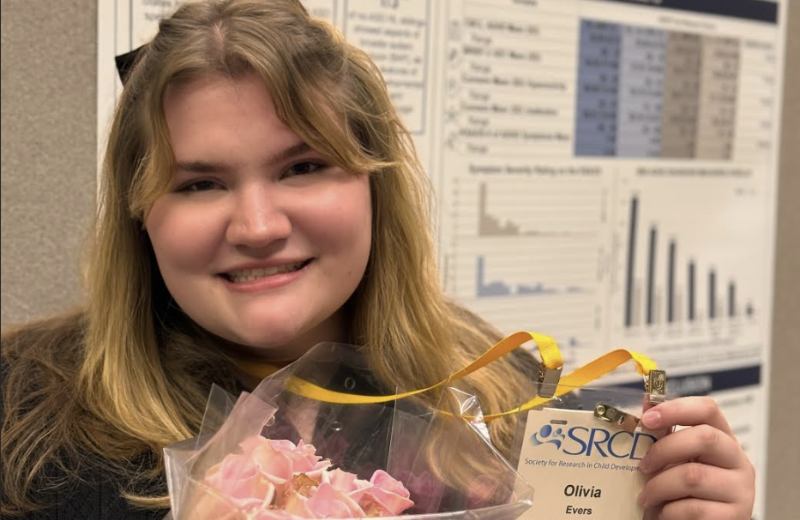
Alt text for photo: Olivia Evers (MN LEND 2024-25) holds a bouquet of pink roses and her presenter badge. She stands in front of a conference poster she co-authored.
Olivia Evers (MNLEND 2024-25) was part of a team that recently unveiled a refreshed online services directory for Proof Alliance , a Saint Paul organization that works to prevent prenatal alcohol exposure and support people affected by fetal alcohol spectrum disorders (FASD).
The Support Services Directory now offers a more functional user navigation system. Evers’ role involved updating service providers on the list who have specialized FASD knowledge.
“These services are actually pretty hard to find, and the directory helps people impacted by FASD who are looking for social skills intervention, diagnosis, behavioral interventions, and other resources,” she said. “It's one of the neurodevelopmental disabilities that's not really talked about as much as others, but it should be because the prevalence is high.”
Evers is a senior at the University of Minnesota, working toward degrees in family therapy and developmental psychology, with a neuroscience minor. She is completing her senior capstone project examining the effectiveness of the Early Head Start program for children with neurodevelopmental disabilities. She is applying to doctoral programs in clinical psychology, and plans to become a pediatric neuropsychologist specializing in neurodevelopmental disabilities.
While it’s a bit unusual to apply to clinical psychology doctoral programs directly from undergraduate school, Evers has been conducting research in the field since her freshman year, including work in co-occurring attention-deficit/hyperactivity disorder (ADHD) and autism within the Infant Brain Imaging Study (IBIS). She has also begun working as a social skills facilitator in the Program for the Education and Enrichment of Relational Skills (PEERS) at the Masonic Institute for the Developing Brain .
“Olivia has been an invaluable team member since she joined my lab as a freshman,” said Casey Burrows (MNLEND 2018-19), an associate professor and psychologist in the University’s Autism and Neurodevelopment Clinic. “She brings team members together and through her leadership and enthusiasm, inspires others to be as passionate about psychology as she is.”
After navigating academic challenges in middle and high school, Evers’ own late ADHD diagnosis set her on her career path to promote early and more equitable diagnoses in the neurodevelopmental disabilities field.
“Once I was diagnosed and had intervention and support, I saw how much my life changed,” she said. “I knew I wanted to be that person who can provide for kids so they might not have to go through the same academic and other hardships. That experience sparked my passion for both research and clinical intervention, and for helping children access the support they need earlier.”
As a MNLEND fellow, she also created a research survey and poster on Identifying the Gaps: Caregiver Perspectives on Fetal Alcohol Spectrum Disorders (FASDs) Resources and Support in Minnesota. The survey showed families are reporting difficulties in finding service professionals who understand FASD, pointing to a need for more specialized training.
“MNLEND taught me that passion matters, but acting on it is how real change happens,” she said. “That includes meaningful connections with the community, powerful advocacy and policy, and intentional translational research.”
View Article