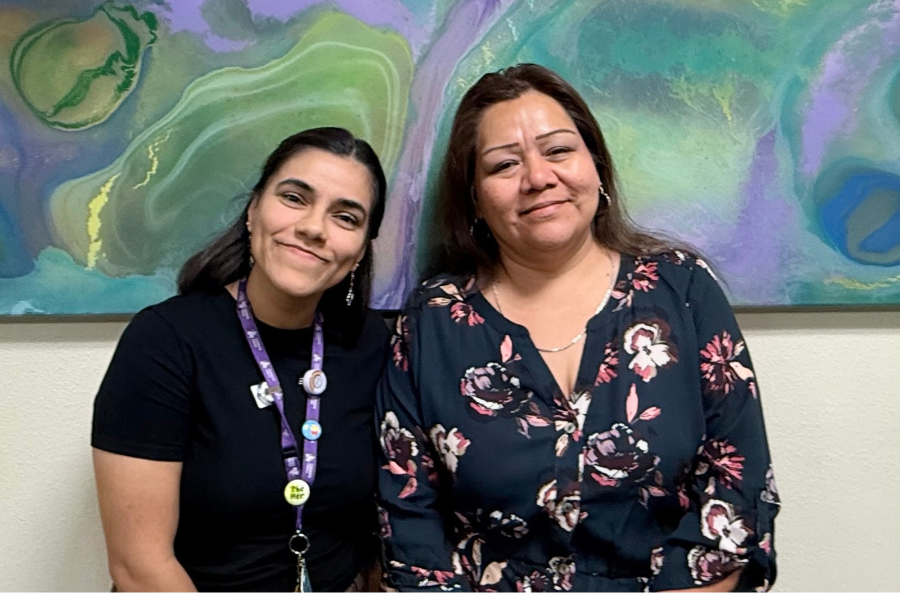
At the core of effective pediatric care is the understanding that families are an integral part of the treatment team. This philosophy is the driving force behind a new parent support and training group called Más Allá de la Maternidad (Beyond Motherhood). The group was launched at Children’s Clinics in Tucson, AZ by two ArizonaLEND alumni: Maritza McCabe, a 2025-2026 Family-Parent discipline alum, and Gabriela Enríquez Hernández, a bicultural Board-Certified Behavioral Analyst (BCBA) and 2022-2023 Applied Behavior Analysis (ABA) discipline alum.
The inaugural cohort of the group, conducted entirely in Spanish, recently concluded to overwhelmingly positive feedback from the local community. As McCabe and Enríquez Hernández prepare to launch an English-language version this semester, they shared insights into the group’s origins, the impact of offering a Spanish-language community, and the importance of centering lived experiences in clinical spaces.
A Catalyst for Connection
The parent group originated from a shared desire to create a welcoming environment for mothers and caregivers of children with disabilities and complex medical needs. The initiative began as an ArizonaLEND research project led by McCabe, building upon an ABA training program that Enríquez Hernández had started several years prior.
"At its core, the group was created to provide meaningful support, connection, and resources for parents of children with disabilities and complex medical needs," they shared jointly. "We wanted to create a welcoming space where mothers and caregivers could connect with others who understand their experiences, feel a sense of belonging, and know that they do not have to navigate their journey alone."
The success of the group lies in its interdisciplinary partnership, merging Enríquez Hernández’s evidence-based professional knowledge with McCabe's lived experience as a mother. "Having a co-facilitator who is also a mother brought an especially meaningful dimension to the group," Enríquez Hernández and McCabe noted. McCabe's personal experience helped create a sense of understanding among participants and strengthened the community's trust and alliance.
The Power of Identity in Community
A defining feature of the first cohort was its delivery entirely in Spanish. Enríquez Hernández has dedicated her career to understanding the treatment acceptability of ABA strategies among Hispanic families. Her previous research utilized an 11-week training based on the Research Units in Behavioral Intervention (RUBI) Autism Network Curriculum to assess the suitability of these strategies.
For Enríquez Hernández and McCabe, providing the group in Spanish was about much more than accessibility; it was about authentic connection. "Being able to participate in their native language allowed parents to see an important part of their identity reflected in their space, which contributed to a strong sense of unity, belonging, and inclusivity," the pair explained. Upon further reflection they shared, “Language carries emotional meaning, and being able to express personal experiences, feelings, and ideas in the language that feels more natural to them, and in the language they lived these experiences, allows participants and co-facilitators to connect on a deeper level.”
Enríquez Hernández drew heavily on her own bicultural upbringing, recalling how she spent her childhood between the United States and Mexico. "My mother played an important role in encouraging me to develop my own identity by embracing where I came from while also incorporating the culture and experiences of the country where I was studying," Enríquez Hernández shared. "Inclusivity is not only having access to an interpreter or providing translated materials. It means creating a system where diverse providers are present and available, and where language, customs, traditions, family values, and cultural perspectives are incorporated into the way we provide care."
Empowering Caregivers and Demystifying Clinical Care
A key goal for both facilitators was to ensure that parents felt confident in their ability to support their children's goals. Enríquez Hernández emphasized that parent confidence in implementing behavioral strategies directly supports treatment fidelity. To achieve this, she focused on explaining the reasoning behind specific interventions, ensuring parents understood they were active decisionmakers on their child's team rather than just followers of instructions.
From the Family-Parent perspective, McCabe prioritized creating a safe environment where caregivers felt heard and understood without communication barriers. To demystify complex clinical strategies, McCabe advocated for keeping information simple to understand and encouraging participation. "By allowing time for open conversations, partnering with community resources that join us in person and an outline of what can be expected, is how practical empowering tools have been used," she explained.
The response from families has been profound. Parents frequently expressed their appreciation for having dedicated time to coming together, leading to a noticeable decrease in feelings of isolation. The group evolved into a space where caregivers could briefly step outside their roles to reconnect with themselves, sharing tears of joy, laughter, and moments of deep vulnerability.
Looking Ahead: The English Cohort
As they prepare for the English-language cohort, McCabe and Enríquez Hernández are carrying forward vital lessons. Chief among them is the intentional creation of space for connection through regular check-ins, icebreakers, and laughter. They also plan to continue encouraging parents to embrace their individuality and express their personalities alongside their caregiving responsibilities.
For McCabe, co-facilitating the group is an opportunity to empower advocacy, helping parents realize that "speaking up isn't a problem but a power."