Network Impact - Maryland
In the last year, the AUCD Network has had a lasting impact on the disability community across the country. Through UCEDDs, LEND programs, and IDDRCs, the Network had a profound impact on the trainings, outreach, and research on autism and intellectual and other developmental disabilities.
Bridging Systems, Building Solutions: South Dakota UCEDD & LEND Drive Change in Underserved Communities
A new one-minute video game is able to accurately and efficiently identify children with autism from those who have Attention-deficit/hyperactivity disorder (ADHD) or are neurotypical.
Developed by researchers at the Center for Neurodevelopmental and Imaging Research at the Kennedy Krieger Institute (KKI) and Nottingham Trent University, the tool is called the Computerized Assessment of Motor Imitation (CAMI). It uses motion-tracking technology to detect differences in motor imitation skills. The center focuses on neuroimaging, and its research is organized into several cores, including one for neuroimaging, which supports projects examining the role of sleep and circadian rhythm dysfunction in children with autism.
In the study, 183 children, ages 7–13, were asked to copy the dance-like movements of a video avatar for one minute, while their imitation performance was measured using CAMI. The video game tool was able to correctly distinguish children with autism vs. neurotypical children with a 80% success rate. CAMI also differentiated autism from ADHD with 70% accuracy. Researchers say that this is a particular challenge because ADHD and autism often co-occur, and it can be hard to identify the diagnoses, even by expert clinicians.
Dr. Stewart Mostofsky, a pediatric neurologist and director of KKI and co-author of the study, says this tool is a step forward in how autism is diagnosed.
“Diagnosing autism can be challenging, especially when children overlap traits with other conditions like ADHD. If the condition is misdiagnosed, it can impact support and resources for the child.” said Dr. Mostofsky.
Diagnosing autism requires highly trained clinicians and costs families an estimated $1,500 - $3,000 annually, according to the U.S. National Library of Medicine.
1 minute | 80% | 183 |
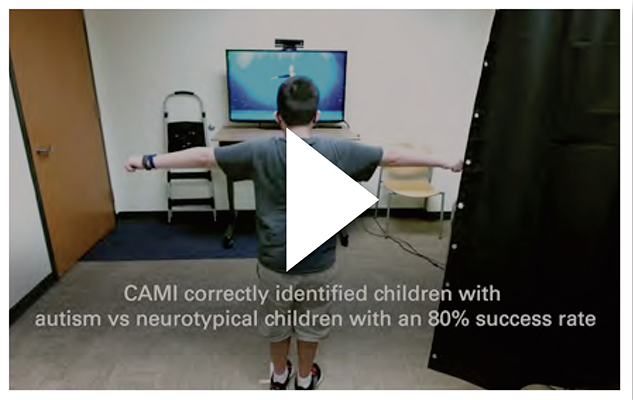
Click here to view full video.
Dr. Bahar Tunçgenç, senior author and social development expert at Nottingham Trent University, said: “Autism is traditionally seen as a social-communication disorder, but we now know sensory-motor difficulties, like motor imitation, play a key role in shaping social and communication skills. CAMI identifies autism by tapping into these challenges, which are distinct from ADHD.” She added, “What makes CAMI exciting is its simplicity. Video games are fun for kids, fast for clinicians, and provide clear results.”
With further development, CAMI could be adapted for younger children and those with more severe developmental challenges, broadening its impact. Researchers hope CAMI’s success inspires new ways to simplify and improve diagnostic tools for other conditions.
“This tool could transform autism diagnoses worldwide. By identifying autism as precisely as possible, we can connect children to interventions that improve their quality of life and long-term outcomes.”- Dr. Mostofsky
Source: Innovative One Minute Video Game Boasts 80 Percent Success Rate in Diagnosing Autism